Suggested Water Colour Art Materials


TIP: Put your name on your tubes of paint when going to a group class

Materials Required

1 x 1-inch flat brush                   1 x 2 inch or 3-inch pastry brush

1 x  size 10  round brush           Container for water

1 x  size 6 round brush              Spray bottle

1 x size 3 round brush               Paper towel or tissues

1 x 1-inch rigger/liner brush      1 natural sponge

Pencils – 2B, 4B, 6B                   1 eraser (kneaded rubber eraser)      

Flat and round brushes on a paint lid

One large sketchbook.  Daler-Rowney makes an A3 220g/m2 acid-free pad in heavy cartridge paper 297 x 420 mm, that is marvellous).  Another good pad is made by Croxley and has a spiral binding and a sketched girl’s face on a yellow background.

Good drawing paper – heavy enough for good sketches with watercolour

Watercolour palette, bigger is better.  (The lid of a plastic paint drum works well).   If you cannot find what you need, just bring a couple of plastic plates for now.

Board for stretching paper.  I have some boards that I have found to be marvellous and they are not heavy and I have some for you to purchase if you care to try this method.  

 Watercolour paper.  There are so many varieties and prices.  Try to purchase the heaviest paper that you can afford, nothing less than a 300 gram, and no tinted papers.   I no longer like the Bockingford make as we have had some real disappointments with this paper. You may also find a pad with sample papers.  This is a good way to experiment and find out what you like best.  Pads that are 15 x 20 inches or 14 x 10 or 16 x 12 are good sizes to begin but try not to get smaller than that initially.  Some makers of paper also make blocks, where the paper is glued down and supposedly already stretched.  I don’t like to use these and always take the paper off anyway.  If these are cheaper, go ahead and buy them, in this way and you can experiment to see what works for you.  I have had more consistent success with, Montval and Daler Rowney Aquafine paper which is in the cheaper range.

My favourite palette

 In South Africa, you can contact Harold Pullen to obtain one of these excellent palettes that have a lid to keep the paint clean and dust-free.

Email: hpullen@saol.com

Middle of the range art paper and more readily available in South Africa

Paints: 

I prefer tubes of paint.  Winsor and Newton are good buys.   It is a good idea to purchase the best quality paints you can afford.  The colours can be a disappointment for you if you go with the cheap boxed colours as they are not true and cause more frustration than anything.  It is better to just buy a few colours at a time and gradually build up your supply.  The following colours are the basics, get the ones with the * first if you intend building up your collection gradually.  After this, you might like to experiment with other colours. Some paints are marked as “hue” these are usually fine for the beginning.

 I change my palette from time to time and for that reason, I have quite a number of the lovely palettes featured above.  At the moment the list below is what I am enjoying:

     Winsor Red
 
Winsor Yellow
    
       Cobalt Blue
Cadmium Scarlet
     Aureolin Yellow
 
Antwerp Blue
      Payne’s Grey
 
Brown Madder Alizarin
      French Ultramarine Blue
 
Cerulean Blue
     Prussian Blue I LOVE Prussian Blue but it is powerful so use with care or with flamboyance.
 
To begin purchasing a suitable and very basic range of colours – this is what I would suggest:       


Yellow:  lemon yellow, yellow ochre or raw sienna
Orange: cadmium orange or chrome orange
Red: alizarin crimson or Winsor red
Blue: cerulean blue, ultramarine blue, cobalt blue
Brown: burnt sienna


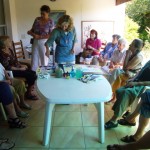
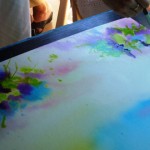
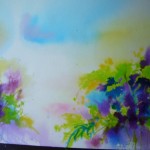
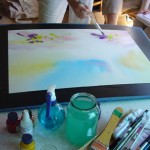
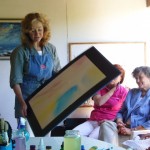
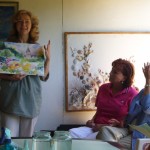
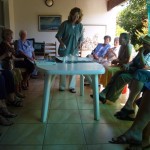
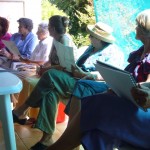
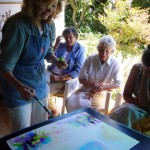
Water Colour Art Dem in Plettenberg Bay, November 17th, 2011

Thank you to the participants of the workshop dem at Joy Robin’s home in Plettenberg Bay.  It was a lovely morning sharing some creative happiness with fellow artists in the garden of this beautiful home, surrounded by flowers and birds.

Thank you Joy Robin for hosting this and for the wonderful tea.  Also thank you to Loren for taking the pictures, sorry the one of you did not come out.

May we all paint with a little more reckless abandon and delight in the serendipity of “what happens by accident”.  Dance, sing and paint, and maybe even buy some tap shoes x

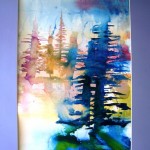
A water colour demonstration will be held in Plettenberg Bay, November 17, 2011, hosted by the Plettenberg Art Group.  Joy will be demonstrating how to paint flowers and buildings. Take a look at some of the art work created in this line.

Sketching "Pate Fois and Gras" our names for the geese in the gardens of Delheim


When we record a home, it is more than just representing the walls and lines, dimensions and colour.  It is more about speaking about the feelings that we sense in that image – capturing the passion of life that surrounds the place.

Please contact Cynthia Ecker  at  camspost@telkomsa.net  for more information.

The Joy of Art at McGregor

Experience the Joy of Art in the Heavenly

Gardens of Temenos, McGregor this spring


3 nights

2 days

1 amazing experience

Come and enjoy a weekend with Joy Truscott as
we delight in the serendipity of watercolours in the sanctuary gardens of
Temenos this spring

http://www.temenos.org.za/retreats.html

Experience The Joy of Art

October 28th to 30th, 2011

Within – Inspired by a photograph by Ken van Wyk


Photograph by Ken van Wyk


Bring your water colour art supplies for a wild and wonderful weekend of creative bliss.

The package is priced at R2 571.83 per person and this will give you access to inspired tuition and guidance in the sanctuary gardens and meditation spaces of Temenos. It includes a welcome dinner meal, breakfast buffet each morning, teas and scones during the course of the day and the option of a “workshop dinner menu” at the very affordable rate of R80 per person.  Accommodation includes Friday and Saturday with Sunday evening included free of charge, courtesy of Temenos.  Shared or single accommodation is available.

Pictures from the weekend

Outside Caritas – Temenos Library and our art studio for the weekend
Lynda Allen and Rose Kent
Graeme Comrie
Marianne Saddingtom
Rose Kent


Sheer Brilliance by Graeme Comrie

Suggested Materials List


1 x 1 inch flat brush                   1 x 2 inch or 3 inch pastry brush

1 x  size 10  round brush           Container
for water

1 x  size 6 round brush              Spray bottle

1 x size 3 round brush               Paper
towel or tissues

1 x 1 inch rigger/liner brush      1
natural sponge

Pencils – 2B, 4B, 6B                   1
eraser (kneaded rubber eraser)      

One large sketch book. 
Daler-Rowney make an A3 220g/m2 acid free pad in heavy cartridge paper
297 x 420 mm, that is marvelous). 
Another good pad is made by Croxley and has a spiral binding and a
sketched girl’s face on a yellow background.

Watercolour palette, bigger is better.  (The lid of a plastic paint drum works well).   If you cannot find what you need, just bring  a couple of plastic plates for now.

Board for stretching paper.  I have some boards that I have found to be marvelous and they are not heavy and I have some for you to purchase if you care to try this method.  (Approx. R40.00).


Watercolour paper.  There are so many varieties and prices.  Try to purchase
the heaviest paper that you can afford, nothing less than a 300 gram, and no
tinted papers.   I no longer like the Bockingford make as we have had some real disappointments with this paper. You may also find a pad with sample papers. 
This is a good way to experiment and find out what you like best.  Pads that are 15 x 20 inches or 14 x 10 or 16 x 12 are good sizes to begin, but try not to get smaller than that
initially.  Some makers of paper also make blocks, where the paper is glued down and supposedly already stretched.  I don’t like to use these and always take the paper off anyway.  If these are cheaper, go ahead and buy them, in this way and you can experiment to see what works for you.  I have had more consistent success with, Montval and Daler Rowney Aquafine paper which is in the cheaper range.

 Paints: 

I prefer tubes of paint. Winsor and Newton are good buys.   It is a good idea to purchase the best quality paints you can afford.  The colours can be a disappointment for you if you go with the cheap boxed colours as they are not true and cause
more frustration than anything.  It is better to just buy a few colours at a time and gradually build up your supply.  The following colours are the basics, get the ones with the * first if you intend building up your collection gradually.  After this you might like to experiment with other colours.  Some paints are marked as “hue” these are usually fine for the beginning.


*      Alizarin Crimson Rose Madder
               Cadmium Yellow *   Lemon Yellow
*      Yellow Ochre Burnt Umber
*      Ultramarine Blue *   Prussian Blue
*      Cobalt Blue *   Cerulean Blue
        Aureolin Yellow *   Sap Green
       Indian Red Raw Sienna
     Chrome  Orange /
Cadmium   Orange
Cadmium Red

Contact
Joy 079 180 7639 or joytruscott@gmail.com to reserve your space.

joytruscott.co.za

I look forward to painting with you.


Intuitive Water Colour Painting Beginnings

In our art classes we like to be a little bit crazy – it helps to have Julio crooning the song “Crazy” in the background.

Heather's amazing work of art created out of her intuitive painting beginning


Colour Theory Workshop in Jeffreys Bay

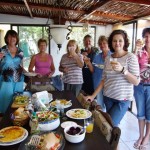
Group of watercolourists from the Eastern Cape Water Colour Society spent a day at our Jeffreys Bay home discovering some fun colour concepts.  Marvelous shared lunch and beach walks in between cups of tea and scones, and happiness with our colours.

Art Dems Out and About

Heidi walked past and joined the group on the spur of the moment and she created an amazing
Dem at Crafty Arts J-Bay 2010